Google's Genie 4 Builds Living Worlds With Sound — But You Can't Build On It Yet
Nothing here is sponsored — no affiliate links on this page. This is researched analysis, not hands-on testing: Genie 4 is in research preview, we have not used it, and the capabilities below are Google DeepMind's claims from its October 27, 2026 announcement, not independently verified results.
Here is the sentence that actually matters about Genie 4: the world now comes with sound. Google DeepMind announced Genie 4 on October 27, 2026, and for the first time in its real-time world-model line, the simulation and the audio are generated together — the ambient noise of a room, music, and characters you can talk to — instead of a silent video with sound bolted on afterwards. That is a real step. It is also, for almost every developer reading this, a waitlist story rather than a tool you can open this week, and this article will keep both of those facts in view at the same time.
🔍 How we put this together
We used Google DeepMind's Genie 4 announcement (authors Raia Hadsell, Diego Rivas and Hang Qi) and Google's own introduction post, both dated October 27, 2026. Where a capability is DeepMind's claim rather than something anyone outside the company has tested, we say so. Availability is stated exactly as Google stated it — no generous reading.What Genie 4 actually is
Genie 4 is a world model: you give it a starting point and it generates an interactive, simulated world in real time, one frame after another, that you can move through. DeepMind's earlier Genie models did the visuals. Genie 4 adds three things that change what the thing feels like to use.
- Native audio, generated with the world. Ambient sounds, music and interactive dialogue come out of the same generation process as the visuals, not as a separate dub. DeepMind says it is the first of its real-time world models to do this. If you have watched a Genie 3 clip, you know the eerie part was the silence. That is gone — or at least, it is gone in DeepMind's demos.
- More convincing worlds. Enhanced photorealism, more fluid movement, and better physics — aerodynamics and collisions get named specifically. The biggest leap, by DeepMind's own telling, is simulated people: how they look, how they move, how they behave around you.
- Live steering. While a scene is running, you can change it with natural-language prompts: move the camera, change the weather, bring in a new character. You are not just watching a generated clip; you are directing it while it plays.
Runtime is about 2 minutes per simulation, roughly double Genie 3's ~1 minute. Two minutes still is not a game session or a film. It is a scene. Keep that scale in mind whenever a demo makes it feel endless — the clip ends, and you start a new one.
How it works, in plain terms
Two Gemini pieces sit underneath Genie 4, and the division of labour is worth understanding because it explains both the strengths and the failure modes.
Gemini Omni anchors the simulation in how the real world looks and behaves. Think of it as the model's sense of what a room, a street or a person plausibly does — the grounding that stops the world dissolving into dream logic. Gemini 3.8 Flash then guides coherence frame by frame, keeping the scene consistent as it unfolds: the same character, the same room, the same weather you asked for, from one moment to the next.
That split is also where you should expect the rough edges. World models are famous for a specific kind of failure: everything looks right for ten seconds, then a door changes place, a character's face drifts, a thrown object forgets gravity. DeepMind's framing — one model for grounding, one for frame-by-frame coherence — is an attempt to push that failure further out. Whether it succeeds on scenes you design, rather than scenes DeepMind chose for a launch video, is exactly what nobody outside the company can verify yet.
The honest availability picture
This is the section most launch coverage will soften, so here it is plainly:
- Now: research preview, available to trusted testers only.
- Coming soon: Google AI Ultra subscribers, inside something called Project Genie.
- Coming soon: early-access partners of the Gemini API and Google AI Studio.
- Open now: a waitlist for Project Genie.
That is the whole list. There is no public API endpoint today, no pricing, no general signup that gets you in this week. If you are a developer who wants to build on this, the realistic move is not "start building" — it is "get on the waitlist and watch the Gemini API / AI Studio early access." Anyone telling you otherwise is selling something.
One more detail worth knowing: all generated video and audio carries Google's SynthID watermark. That is good practice, and it also tells you something about how Google expects this to be used — generated worlds that are identifiable as generated, not passed off as footage.
Why developers should care anyway
A waitlist story can still be worth your attention if it changes what becomes possible. Genie 4 does, in one specific area: training environments.
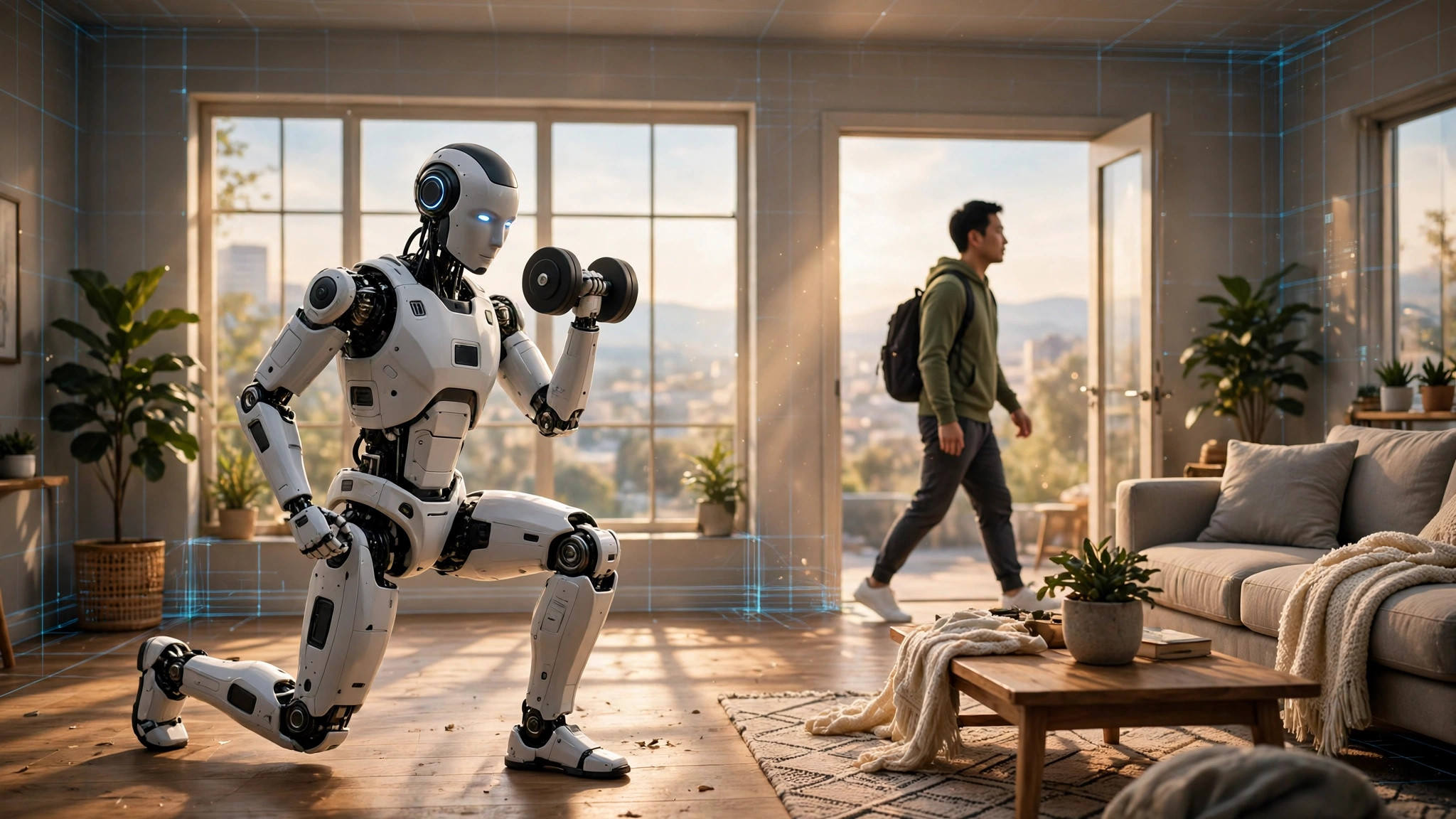
Robots and agents learn by doing, and doing things in the real world is slow, expensive and occasionally destructive. A simulated world you can vary infinitely — different rooms, different weather, different people walking through — lets a robot practise thousands of variations of a task without ever touching a real object. DeepMind says it tested Genie 4 with Gemini Robotics and with Apptronik's Apollo humanoid. That is the use case to take seriously: not a demo of a robot in a fake living room, but the idea that the fake living room becomes the training gym.
The same logic reaches two other fields. Film previsualisation: a director blocks a scene, changes the weather mid-take, moves the camera, all before a crew is booked. Game prototyping: a designer walks through a level that does not exist yet, talks to a character who was not written yet, and decides in an afternoon whether the idea is worth building properly. Both are real, and both are still "try it when you can get in" rather than "ship it now."
What Genie 4 is not, yet: a production tool. Two-minute runtimes, preview-only access, and vendor-only testing mean the right response is curiosity with a calendar reminder, not a roadmap rewrite.
What to watch — and what to do this week
- Join the Project Genie waitlist if you want a shot at the Ultra-subscriber rollout. It costs nothing and it is the only door actually open.
- Watch the Gemini API and Google AI Studio early access — that is the door that matters for developers, because it is the one that turns a demo into something you can call from code.
- Do not build a product plan on Genie 4's demo behaviour. No pricing, no rate limits, no API surface and no independent testing exist yet. A plan built on a launch video is a plan built on marketing.
- When you do get in, test the failure modes first. Long scenes, crowded scenes, fast camera moves, characters who leave and come back. That is where world models break, and that is what will decide whether Genie 4 is a toy or a tool for your use case.
- Keep an eye on the audio story specifically. Native dialogue in a generated world is the least-proven part of this launch — and if it holds up, it is the part that changes game prototyping and training most.
FAQ
What is Google DeepMind Genie 4?
A real-time world model announced October 27, 2026. It generates an interactive simulated world plus native audio at the same time — ambient sounds, music and interactive dialogue — and the running scene can be steered with natural-language prompts.
Can developers use Genie 4 today?
No, not generally. It is in research preview with trusted testers. Google says it is coming soon to Google AI Ultra subscribers in Project Genie and to early-access partners of the Gemini API and Google AI Studio, and there is a waitlist for Project Genie.
How is Genie 4 different from Genie 3?
Genie 4 adds native audio generated alongside the world, more photorealistic visuals with better physics and simulated people, live steering of a running scene, and about double the runtime — around 2 minutes versus Genie 3's roughly 1 minute.
Why should developers care about Genie 4?
Because infinitely variable, safe simulated environments are how robots and agents get trained without breaking real things. DeepMind tested Genie 4 with Gemini Robotics and Apptronik's Apollo humanoid, and the same tech points at film previsualisation and fast game prototyping.
Does Genie 4 output carry a watermark?
Yes. All generated video and audio carries Google's SynthID watermark, identifying it as AI-generated.
Sources: Google DeepMind — Genie 4: A new generation of world simulation · Google Blog — Introducing Genie 4