Runway Just Open-Sourced a Robot Brain That Beats Nvidia's
Nothing here is sponsored — no affiliate links on this page. Every fact below comes from Runway's Praxis-1 announcement of November 11, 2026, checked the same day. We have not run Praxis-1 hands-on — nobody outside Runway's partner group has had it long enough — this is researched analysis, not hands-on testing. Benchmark figures are Runway's own, with no independent verification yet.
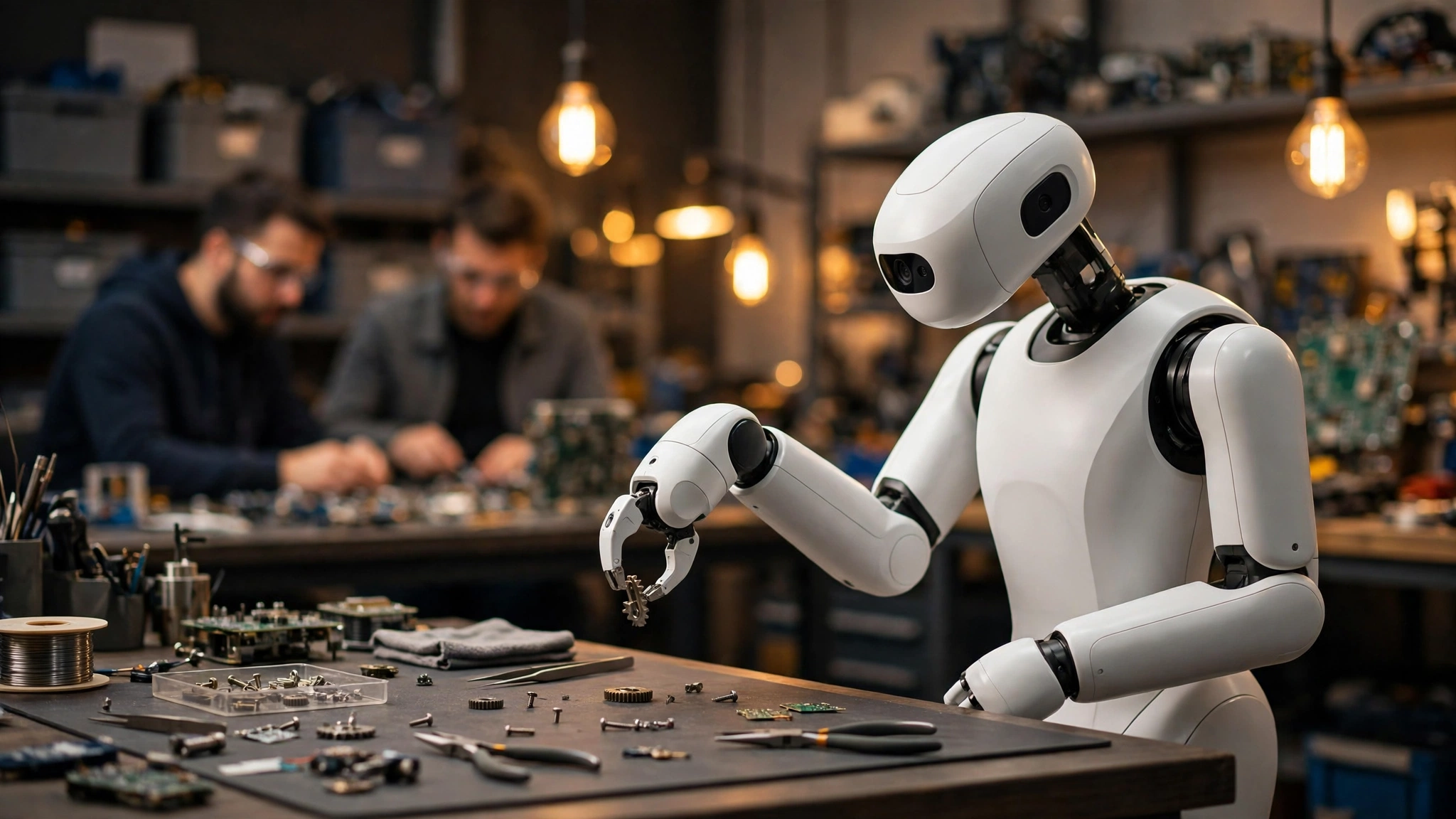
Yesterday afternoon, Runway did something the robotics world has been waiting on since September: it released Praxis-1, its "world action model" for robots, with open weights under the Apache 2.0 license. Free to use, free to modify, free to build a business on.
🔍 How we put this together
We used Runway's official Praxis-1 announcement of November 11, 2026 — the model description, the RoboLab-120 leaderboard numbers, the RT-1 fine-tuning result, the license, the hardware list and the launch partners — and independent coverage the same day. Where something is a vendor claim or an unverified benchmark, we say so.What actually shipped
Praxis-1 is a 27-billion-parameter mixture-of-experts diffusion transformer. The jargon hides a simple idea: it predicts video and robot actions together. Show it what a task looks like, and it figures out both what should happen next and how the robot's body should move to make it happen.
It is built on the same large-scale video pretraining behind Runway's general world models — the same stack that learned how the world moves from watching enormous amounts of video. A robot brain, in other words, grown out of a video model rather than out of a robotics lab.
On Nvidia's RoboLab-120 leaderboard — 1,200 episodes of real robot tasks — Praxis-1 scores 46.2% success. That puts it ahead of FLUX 3 Action (42.9%), Nvidia's own Cosmos3 Nano (36.8%), and Physical Intelligence's π0.5 (28.0%). It is, by Runway's numbers, the best-performing world action model in the world right now, and you can download it tonight.
The bet that matters: video instead of robot demos
Here is the part worth paying attention to, because it is the whole thesis of the release.
Most robot policies are trained on teleoperated demonstrations — a human driving a robot arm through a task, over and over, recording every movement. That data is slow to collect, expensive, and scarce. It is the bottleneck on the entire field. Runway's CTO Kamil Sindi put it plainly: "Most robot policies are bottlenecked by robot data, which is scarce and expensive to collect. Praxis-1 learns mostly from third-person video."
Third-person video means ordinary video — the kind already sitting on the internet in effectively unlimited quantities. Runway says its research shows web video matches teleoperated robot video as pretraining data for policy performance. If that holds up outside Runway's labs, the ceiling on a robot policy stops being "how many demos can you afford to collect" and becomes "how much video can you learn from." That is a very different ceiling, and video labs — Runway, Google, the big model shops — suddenly have a head start over robotics labs.
It is a big claim, and it is the claim to watch. The benchmark below is one data point in its favour; independent replication is the real test.
The numbers, with the honest caveat
On RoboLab-120, 1,200 episodes, Runway's own numbers:
- Praxis-1: 46.2%
- FLUX 3 Action: 42.9%
- Nvidia Cosmos3 Nano: 36.8%
- Physical Intelligence π0.5: 28.0%
There is a second number that is arguably more interesting. Runway fine-tuned Praxis-1 on Google's RT-1 robot — a machine that never appeared in its training data — and it reached 80.0% success on SimplerEnv, against 52.4% for RT-1's original control software. That is the generalisation test: a model that has never seen this robot still learns to drive it, quickly, from a small amount of fine-tuning.
Both numbers are Runway's own, with no independent verification yet. Treat them as a strong signal, not a settled fact. The open weights are exactly what lets the community check.
How to try it
This is where the Apache 2.0 license earns its keep. Everything you need is out today:
- Weights and code on GitHub and Hugging Face, with native LeRobot support
- Inference and fine-tuning code included, with full fine-tuning and LoRA support — adapt it to your own robot, cameras and tasks without retraining the whole model
- vLLM-Omni support, and hosted inference on Reactor if you don't have your own GPUs
- Hands-on tutorials for post-training with NeMo Automodel, plus a Runway Dev playground to try it without installing anything
Hardware-wise, it runs out of the box on Nvidia H100 and B200 in the data centre, RTX 5090 and RTX PRO 6000 on a workstation, and Jetson Thor inside the robot itself. That last one matters: the model is meant to run on the robot, not only in the cloud.
Who is already running it
Three launch partners have been running Praxis-1 on their own hardware since the September announcement: Noble Machines (a legged humanoid doing bimanual manipulation), Standard Bots (the RO1 six-axis industrial arm), and Ultra (a dual-arm warehouse robot). One checkpoint, three very different bodies — that is the point of a general model, and it is the claim the RT-1 result backs up.
Should you care?
- You're building robots and your data budget is the bottleneck: this is the most interesting open-weight release of the year. Download the weights, try LoRA fine-tuning on your own hardware, and see whether the video-pretraining head start is real on your tasks.
- You're a developer curious about physical AI: the barrier to entry just dropped to a Hugging Face download and an RTX 5090. The LeRobot integration means the hobbyist toolchain works out of the box.
- You run Nvidia's Cosmos or π0.5 today: nothing in this release forces a switch, but the leaderboard gap and the Apache 2.0 license make Praxis-1 the thing to benchmark against this week.
- You were waiting for the open release since September: it is here, today, as promised — "in the coming months" turned out to be two.
What it means for developers
This lands a day after Google DeepMind put Gemini Robotics 2.5 into Mercedes-Benz factories. The two announcements point the same way — video-trained robot brains are the race now — but they disagree on openness. DeepMind's model is partner-only; Runway's is on Hugging Face. That difference is the story of the next year in robotics.
Runway committed in September to shipping Praxis-1 as an open model, and today it kept that promise. The weights are out. Now we find out whether video really can replace robot demos — and the whole field gets to check the answer together.
What we don't know yet
- Whether the benchmarks reproduce: RoboLab-120 numbers are Runway's own. Independent reproductions should arrive within days now that the weights are public.
- Whether the video-training bet generalises: the RT-1 result is one robot; the field needs ten before the claim is settled.
- How LoRA fine-tuning behaves on unusual hardware: partners have adapted one checkpoint to three embodiments, but your robot, cameras and tasks are your own test.
- What the community builds first: open weights plus LeRobot support usually means hobbyist robots within weeks — watch what shows up on Hugging Face.
Sources: Runway, "Praxis-1 Is Now Available," November 11, 2026 (runway.com); independent coverage via Mad Robot, November 11, 2026. Benchmark figures are Runway's own and have no independent verification yet. Praxis-1 is released under the Apache 2.0 license.