Apple's First Touchscreen MacBook Pro Is Real: PROLED XDR, M5 Pro and M5 Max, From $2,899 — Explained Honestly
Nothing here is sponsored — no affiliate links on this page. Every fact below comes from Apple's October 28, 2026 announcement, as reported the same day. We have not tested this machine, and this is researched analysis, not hands-on testing.
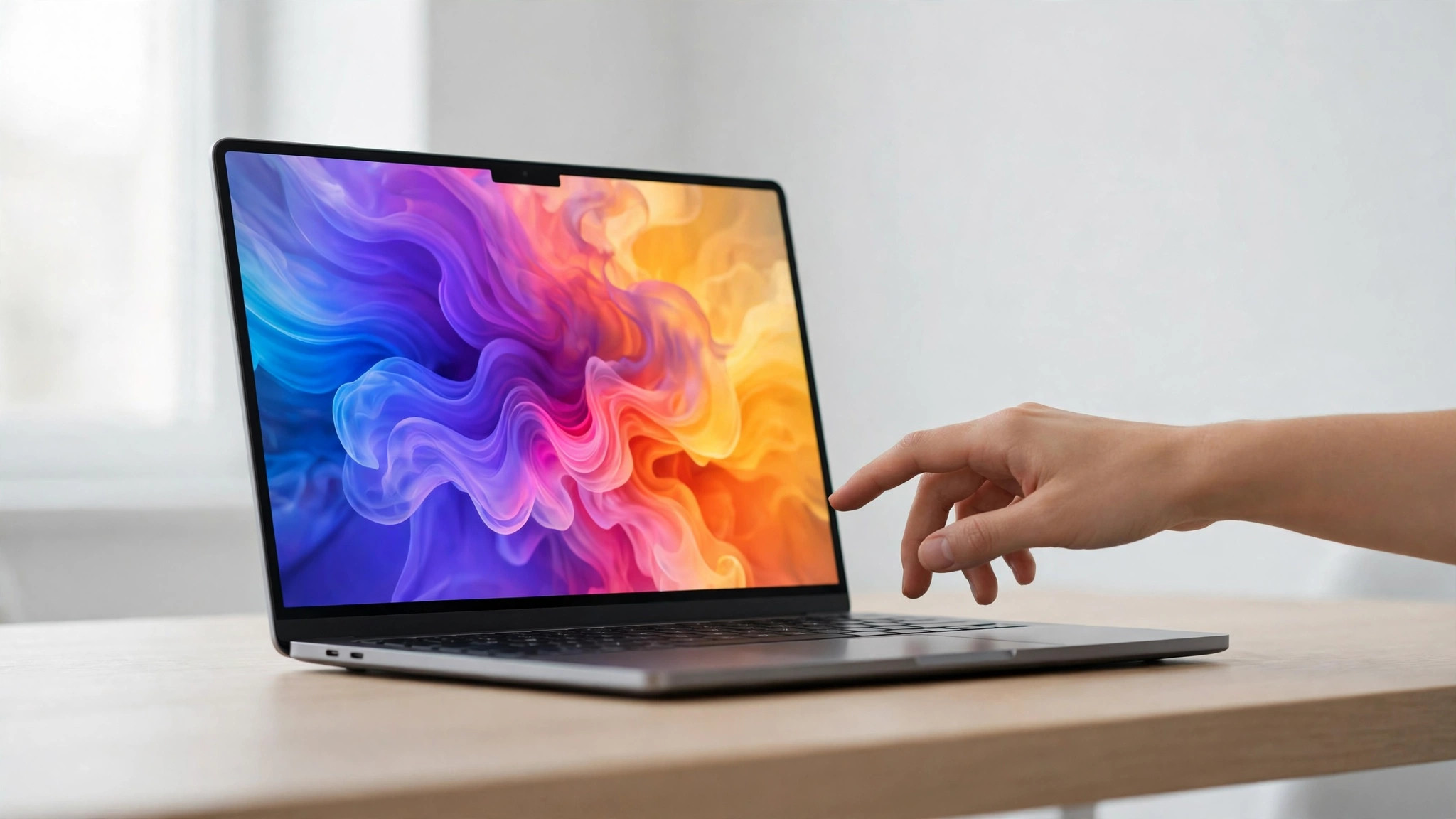
After years of Apple saying no, the touchscreen Mac has arrived — and it is not a compromise machine. Announced on October 28, 2026, the new MacBook Pro with PROLED XDR Display is the first Mac you can touch: a tandem-OLED screen with a touch sensor built into the panel, M5 Pro and M5 Max chips, a Dynamic Island on a Mac for the first time, and a starting price of $2,899. It is a genuinely big shift, and it is also a machine you should think carefully about before buying — because Apple announced a second, much cheaper MacBook Pro the day before, and confusing the two would be a $900 mistake. Here is the whole picture, honestly.
🔍 How we put this together
We used Apple's October 28, 2026 Newsroom announcement as reported the same day by MacObserver, The Apple Post, TechFeatured, Gulf Today and TechToday. Where something is Apple's claim rather than something we have verified ourselves, we say so — and the prices, display specs and availability below are Apple's stated figures, not our measurements.What shipped
Touch, finally, on a Mac. The touch sensor is integrated directly into the display panel rather than layered on top, which Apple says cuts latency. You can scroll a page, pinch to zoom a photo, drag and drop, double-tap a window to fill the screen, flick a window to tile it, draw on the canvas, and play software instruments. The keyboard and trackpad stay — touch works alongside them, not instead of them. Many existing apps work right away because macOS translates touches into clicks, and developers get updated system gesture APIs.
The PROLED XDR display is the other headline. It is a tandem OLED panel — two self-illuminating pixel layers — rated at up to 2,000 nits peak brightness for both HDR and SDR content, with a 10,000,000:1 contrast ratio. ProMotion adjusts refresh from 10Hz up to 120Hz. The gamut covers both P3 and Adobe RGB in a single default preset, so photo and print work no longer needs a mode switch, and a nano-texture finish is optional.
Dynamic Island comes to the Mac. It becomes the home for Spotlight, Live Activities and Siri AI, and a place to control music, answer calls and accept AirDrop requests from the top of the display.
M5 Pro and M5 Max only — no M6 here. The touch models run M5 Pro or M5 Max, with up to 128GB of unified memory and up to 16TB of storage. Apple claims the M5 Max can run large language models with hundreds of billions of parameters entirely on device — its claim, not a benchmark we have seen. The machines are thinner and lighter than before: the 14-inch model is 3 lb (1.36 kg), the 16-inch is 4 lb (1.81 kg), and battery life reaches up to 24 hours on Apple's testing. Ports are three Thunderbolt 5 ports, HDMI, an SDXC card slot, MagSafe and a headphone jack, plus Wi-Fi 7, Bluetooth 6 and a 12MP Center Stage camera. It ships with macOS 27.
Prices and availability — and the $900 trap
US starting prices, as announced:
- 14-inch with M5 Pro: from $2,899
- 16-inch with M5 Pro: from $3,399
- 14-inch with M5 Max: from $4,499
- 16-inch with M5 Max: from $4,799
Pre-orders opened on October 28, 2026, and the machines reach customers and Apple Stores from Friday, November 6, 2026.
Now the trap. On October 27, Apple announced a separate 14-inch MacBook Pro with M6, starting at $1,999 — $900 less than the cheapest touch model. That machine is NOT a touchscreen machine: it keeps the Liquid Retina XDR display (1,600 nits peak HDR, 1,000,000:1 contrast), has Thunderbolt 4 rather than Thunderbolt 5, tops out at 32GB of memory, and supports two external displays. It also pre-orders from October 28 and arrives November 6, so timing will not save you from mixing them up. If a listing just says "new MacBook Pro," check the chip and the display before you pay.
What it means for developers
Touch APIs are now a Mac thing. Apple has updated its system gesture APIs, and macOS translates touches into clicks for existing apps, so most software gets basic touch support without a rewrite. The real work — and the real opportunity — is in apps where touch genuinely helps: drawing and painting (Pixelmator Pro gets touch canvas features), music (Logic Pro adds a multi-touch polyphonic keyboard with chord and drum pads), and video (Final Cut Pro gets pinch-to-zoom on cuts). Third-party touch support from Microsoft Word, Adobe Lightroom, DaVinci Resolve and Blender is promised, but Apple notes those arrive later in the year — so do not buy on the strength of an app that has not shipped its touch update yet.
Test iOS and iPadOS apps natively, on a Mac that finally speaks touch. This is the quiet developer win. If you build for iPhone or iPad, a Mac with a real touch panel is the closest thing to testing your app's touch behaviour without reaching for a device. That does not replace device testing, but it closes a gap that has annoyed Apple-platform developers for years.
On-device LLM capacity is the M5 Max argument. If Apple's claim holds — models with hundreds of billions of parameters running entirely on device — the M5 Max touch model becomes a serious local-inference workstation, with 128GB of unified memory behind it. Treat that as a claim to verify against independent benchmarks, not a reason to order today.
The practical buying split. If you write, code, browse and edit casually, the $1,999 M6 model gets you the same up-to-24-hour battery life for $900 less, and touch adds little to your day. If you grade video, edit photos for print, draw on screen, or need more than 32GB of memory or more than two external displays, the PROLED XDR model is the one that actually changes your work.
The catches, stated plainly
No hands-on testing yet — by us or anyone outside Apple's hands-on event. Everything above is Apple's announcement, shown at a "Pro and tell" hands-on in Los Angeles. How the machine feels after a week of real tapping is unknown, and that matters more here than for most launches.
The hinge question is unanswered. Apple says a redesigned hinge keeps the screen steadier while you tap, and video stabilisation smooths your camera feed if you touch the screen during a call. Whether a laptop screen stays put under repeated tapping — the reason Apple resisted touch Macs for so long — is exactly the thing only weeks of reviews will settle.
macOS 27: designed for touch, or merely tolerant of it? Translating touches into clicks makes old apps work, but it does not make them feel designed for fingers. Until reviewers live with macOS 27, we do not know whether touch on this Mac feels native or like a translation layer you tolerate.
Touch alone does not change what the machine can do. A touchscreen does not add a new capability to macOS — it adds a new way to reach the capabilities that are already there. If your workflow is keyboard-first, this is a very expensive way to scroll a web page.
What to do this week
- If you are about to buy a MacBook Pro: check the chip and display on the listing — M6 with Liquid Retina XDR means no touch and $1,999; M5 Pro or M5 Max with PROLED XDR means touch from $2,899. Do not trust "new MacBook Pro" alone.
- If you build iOS/iPadOS apps: wait for the first touch-API reports and reviews before budgeting for one — the native-testing argument is real, but it depends on how well macOS 27's touch translation holds up in practice.
- If you run local models: wait for independent M5 Max benchmarks on large models before treating Apple's hundreds-of-billions-parameters claim as a purchasing reason.
- If you grade video or print photos: the PROLED XDR display — tandem OLED, 2,000 nits, Adobe RGB, 10,000,000:1 contrast — is the strongest reason to pay the premium, and it is verifiable the moment review units land.
- If you mostly write and code: save the $900. The M6 model matches the touch machine on battery life, and touch will not make your code compile faster.
- Whatever you do: do not pre-order on announcement-day excitement alone — the November 6 reviews will answer the hinge and the macOS-27-feel questions, and the machine will still be there on November 7.
What we don't know yet
- Hinge stability under real tapping: Apple's redesigned hinge is a claim, not a verdict — weeks of use will tell.
- Whether macOS 27 feels designed for touch: click translation is confirmed; a genuinely touch-native feel is not.
- Third-party touch timelines: Word, Lightroom, DaVinci Resolve and Blender touch support is promised for later in the year, with no firm dates.
- Independent M5 Max LLM benchmarks: Apple's on-device claim for very large models awaits verification.
- Real-world battery life: up to 24 hours is Apple's tested figure, not a review measurement.
None of that takes away from the headline: after years of saying no, Apple has shipped a touchscreen Mac, and it did so on its best display and its pro chips rather than as a gimmick on a cheap machine. The developers and creators who benefit most will be the ones who buy it for the display and the memory, treat touch as a bonus until reviews land, and — above all — do not accidentally pay $2,899 for the machine they meant to buy at $1,999, or vice versa.
Sources: Apple Newsroom press release, October 28, 2026, as reported by MacObserver (https://www.macobserver.com/news/touchscreen-macbook-pro-oled-price-release-date/), The Apple Post (https://www.theapplepost.com/2026/10/28/73722/apple-unveils-all-new-macbook-pro-with-touch-proled-xdr-and-m5-pro-and-m5-max/), TechFeatured (https://techfeatured.com/20591/apple-touchscreen-macbook-pro-proled-xdr-price-november-6), Gulf Today (https://www.gulftoday.ae/news/2026/10/29/apple-unveils-its-first-touchscreen-macbook) and TechToday (https://techtoday.space/blog/apple-touchscreen-macbook-pro-explained). All specifications and prices are Apple's claims; this article is researched analysis, not hands-on testing.